Call IQ (preview)
Overview
Call IQ lists your calls with how each one sounded, and ranks the ones worth a second look so you do not have to listen to everything. It lives in the myCloudPBX Service Portal and is switched on by the Early Adopter Program.
Call IQ has two sections, listed under Call IQ in the menu:
- Explorer, every call in the window with its outcome, who answered and its sentiment.
- Review today, a ranked list of recent calls worth a second look.
Choosing Call IQ in the menu opens the Explorer. The breadcrumb at the top of the page names the section you are in.
Summaries, transcripts and sentiment only exist for recorded calls. Call Recording must be on for the phone system and for the numbers or extensions you want covered, and Call Transcription must be set to Transcribe or Call Recording Intelligence. See Joining the program for how to set the level. Calls that were not recorded still appear in the Explorer, without sentiment.
This feature is on preview
A notice at the top of Call IQ says it is still being tuned. Choose 'Got it' to hide it. If Call IQ gets a call wrong, tell us using the feedback prompts described below.
Sentiment
Sentiment is the tone of the words on a call, scored from -1 (very negative) to +1 (very positive) and shown as one of five bands.
| Band | Score |
|---|---|
| Very negative | -0.6 or lower |
| Negative | above -0.6, up to -0.2 |
| Neutral | between -0.2 and +0.2 |
| Positive | +0.2 up to +0.6 |
| Very positive | +0.6 or higher |
A call with several recordings gets the average of their scores.
Sentiment describes tone only. It does not say whether the call was handled well. A caller told their order is late will sound negative however well the call goes.
Each call is also split into five equal parts from start to end, and Call IQ shows how the tone moved across them as a small arc of five dots. Dots above the dashed line are positive and dots below it are negative. The last dot is larger because where a call ended matters most. When the tone rose or fell over the call, an arrow says it Got better or Got worse. Most calls hold steady, which is normal and not a sign that anything is missing.
Explorer
Explorer lists every call in the window, who answered it and how it sounded.
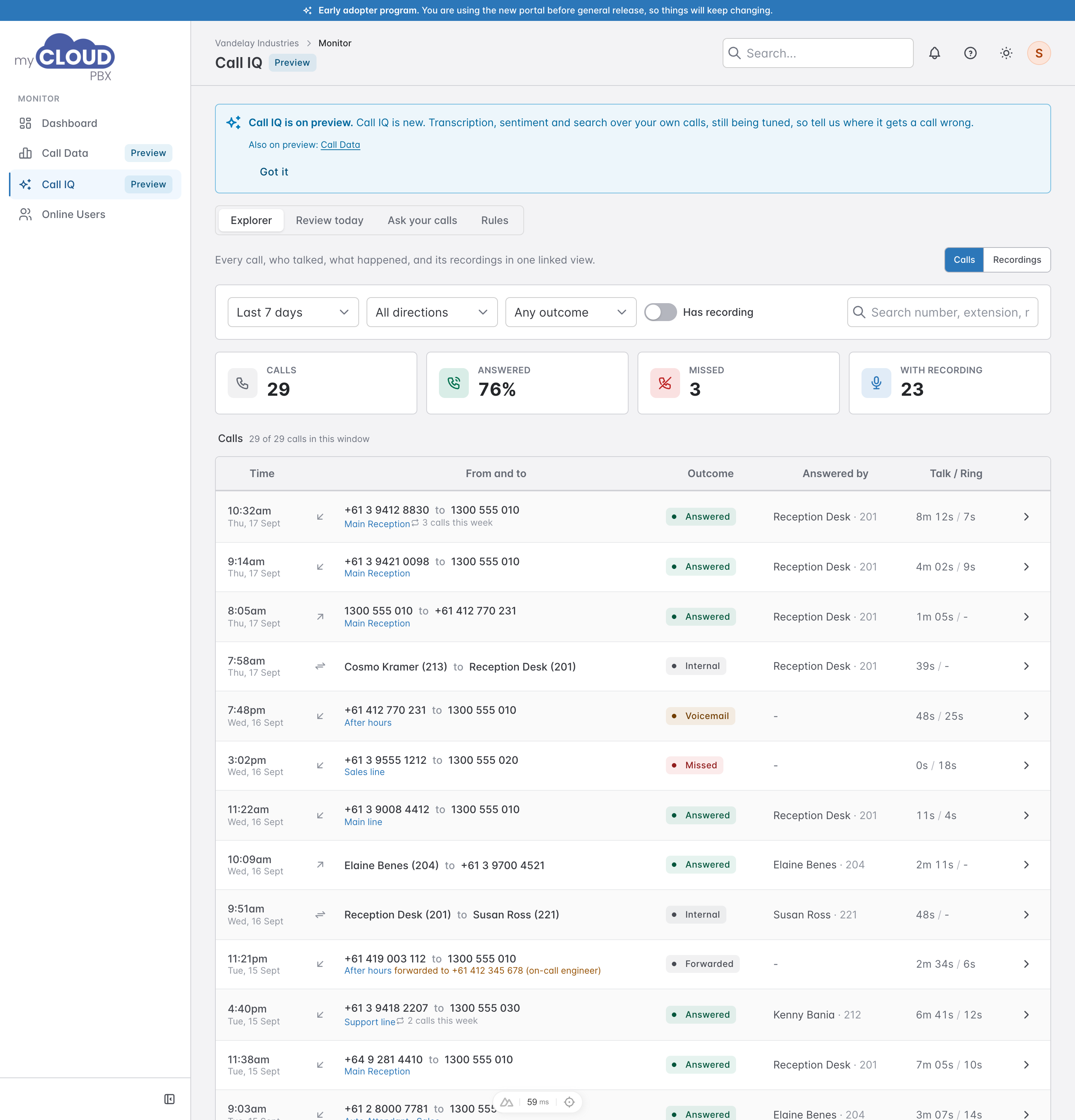
Filters. Choose the window ('Today', 'Last 7 days' or 'Last 30 days'). Today starts at midnight. Narrow by direction (inbound, outbound or internal) and by outcome (answered, voicemail, forwarded, missed or internal). Switch on 'Has recording' to show only recorded calls. The search box matches numbers, extensions, extension names and route names.
Tiles. Calls in the window, the percentage answered (internal calls count as answered), missed calls, and how many have a recording. The tiles follow the filters.
The list
| Column | What it shows |
|---|---|
| Time | When the call started, with the day beneath. |
| Direction | An arrow for inbound or outbound, or two arrows for an internal call. |
| From and to | The numbers, or the name and extension for anyone on your phone system. The route the call came in on is shown beneath. Forwarded calls say where they went. A marker such as '3 calls this week' shows when the same number appears more than once in the window. |
| Outcome | Answered, Voicemail, Forwarded, Missed or Internal. |
| Answered by | The person and extension who picked up. A dash means nobody answered, or the platform could not say who did. |
| Talk | How long the conversation lasted. |
| Recordings | How many recordings the call has. Shown on wider screens. |
| Sentiment | The call's band, with an arrow if it got better or worse during the call. Hover the arrow to see which. 'Not analysed' means the call was recorded but has not been scored yet. A dash means there is no recording. |
The count beside the title shows how many calls are listed out of the total in the window. Choose 'Show more' at the bottom to load the next 100.
Click anywhere on a row, or the arrow at the end of it, to open the call.
No calls showing?
If the window is empty, Call IQ says when the newest call data is from. Try 'Last 30 days'.
Call detail
The call detail opens as a panel over the page and brings everything about one call into one place. On a wide screen the transcript sits on the right. On a narrower one it sits below.
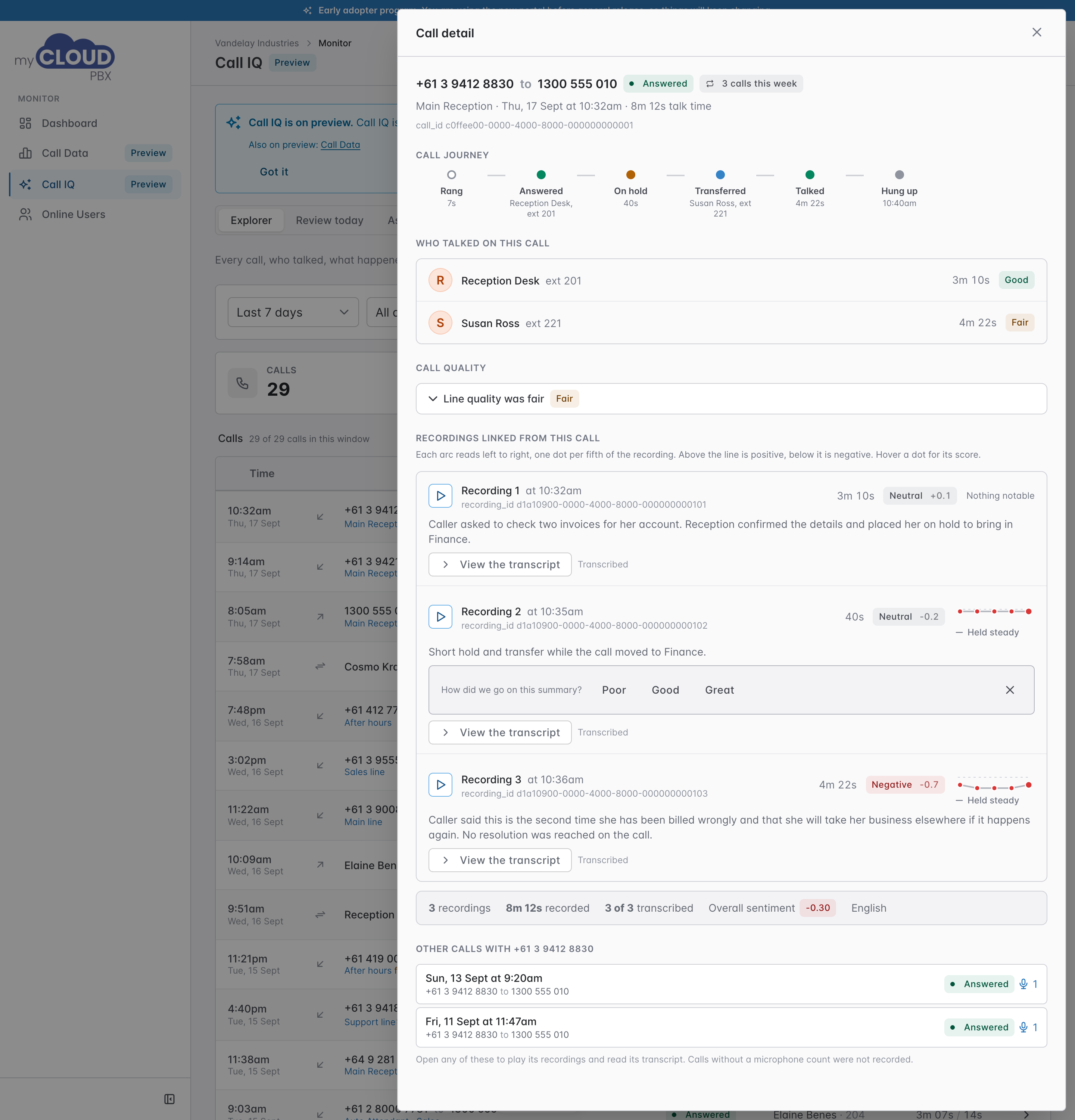
The top of the panel shows who called whom, the outcome, the route, the date and time, and the talk time.
| Section | What it shows |
|---|---|
| Summary | A plain language summary of the recording open in the transcript, for example 'from recording 1 of 3'. Choose another recording to see its summary. |
| Call journey | What happened in order: answered, transferred, on hold, talked, hung up, with who and how long at each step. |
| Before anyone picked up | Menu choices the caller made and time spent waiting in a queue. Shown only when the call went through a menu or queue. |
| Who talked on this call | Each extension that took part and how long they talked. |
| Recordings | Each recording with a play button, the time it started and its length. Click a recording's name to show it in the transcript. The strip beneath totals the recordings, the time recorded, how many are transcribed and the language. |
| Caller experience | The call's sentiment band, its score (averaged across recordings when there are several) and the arc showing how the tone moved. The i icon explains what sentiment measures. |
| Call quality | A line quality grade. Expand it to see the MOS score it comes from. MOS is a standard 1 to 5 measure of how a call sounds. |
| Other calls with this number | The caller's other recent calls, with how many recordings each has and its outcome, so you can see the pattern and not just the one call. Open any of them to switch to it, and use 'Back' to return. |
Transcript
The transcript shows which recording you are reading (for example 'Recording 1 of 3'), how many lines it has, and whether transcription has finished. Use the arrows beside it to step between the call's recordings.
- Play the recording from the bar at the top. The words follow along as it plays.
- Click a line to jump the recording to that point.
- Find a word with the search box. Matches are highlighted and counted.
- If you scroll away while it is playing, the transcript stops following. Choose 'Show current line' to catch up.
Speakers are labelled Speaker 1 and Speaker 2.
Close the panel with the X at the top right or the Esc key. Each call has its own address, so you can copy the link from your browser and send it to a colleague.
Tell us when it is wrong
Under some summaries and transcripts you will see 'How did we go on this summary?' or 'How did we go on this transcript?' with Poor, Good and Great. One click tells us whether that particular summary or transcript was right. The prompt appears on a sample of calls rather than every one, and the X hides it. This is the most useful thing you can do while Call IQ is on preview.
Review today
Review today ranks recent calls by how much they deserve a second look. It holds up to 12 calls from the last seven days, and only calls whose recordings have been scored for sentiment.
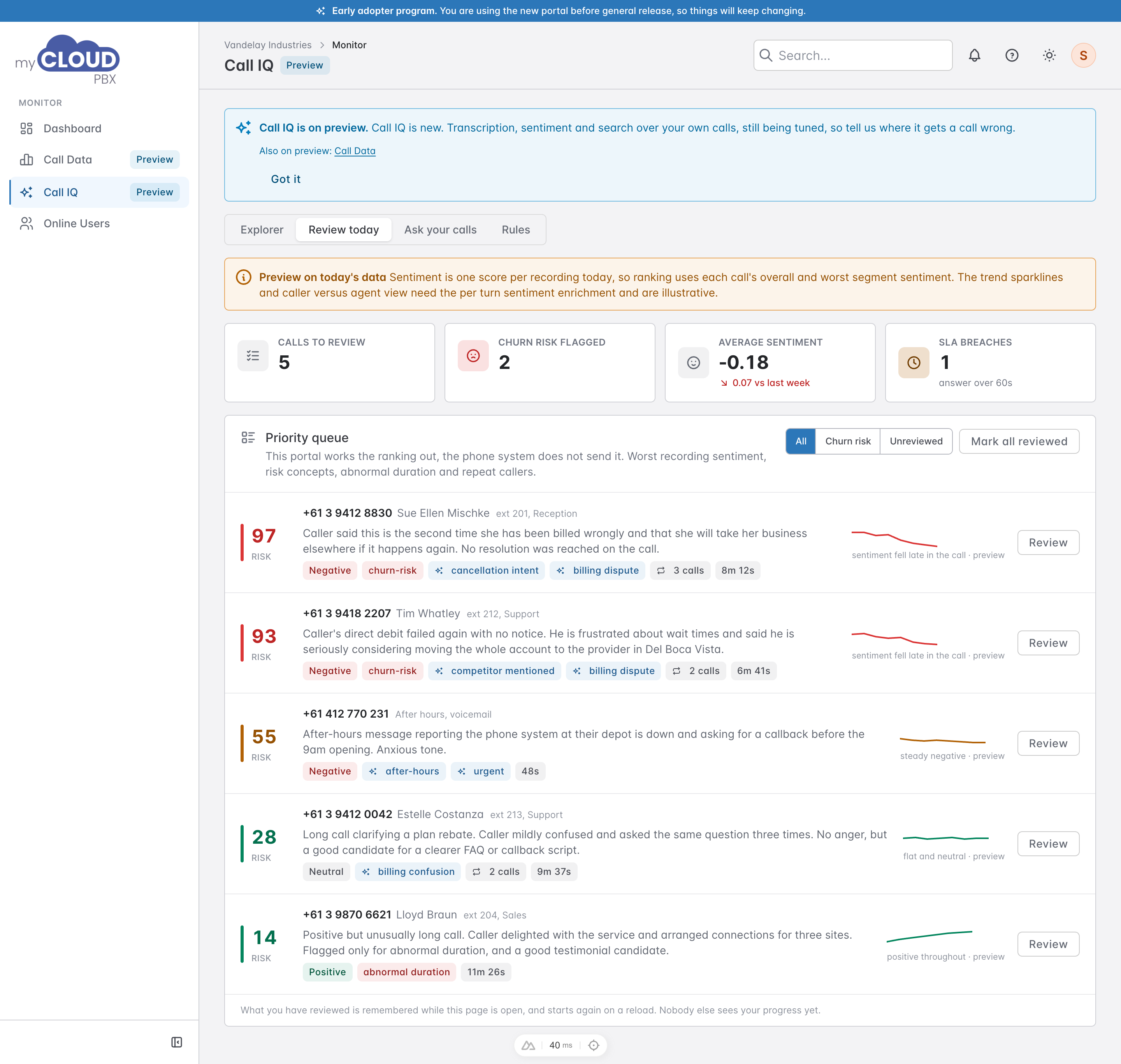
Tiles.
| Tile | What it counts |
|---|---|
| Calls to review | How many calls are in the list. |
| Negative tone | Calls in the list whose sentiment is negative or very negative. |
| Average sentiment | The average across every scored recording in the last seven days, as a band with the score and number of recordings beneath. |
| Long calls | Calls in the list that ran over ten minutes. |
Each call. The priority number sits on the left. Next to it are the direction, the caller's number, and who handled the call (or the route, for a call to a main number). Beneath are the summary, the sentiment band with its score, and the call length, marked 'Long call' when it ran over ten minutes. The arc on the right shows how the tone moved, with Got better or Got worse beneath it when it changed, and Nothing notable when it held flat.
How the priority is worked out
Each call gets a priority from 0 to 99. The portal works it out from two things:
- Sentiment. Very negative calls start highest, then negative, neutral and positive.
- Length. A call that ran past five minutes gains up to 20 more points. The longer it ran, the more it gains, but each extra minute counts for less.
The colour of the bar beside the number shows the band: red for 70 and above, amber for 45 to 69, and grey below 45. Hover 'priority' for a reminder that the score is worked out in the portal and is not sent by the phone system.
Working through the list
Filter with 'All', 'Negative tone' or 'Not reviewed'. Choose 'Review' on a call to open its detail. The call is then marked as reviewed and fades in the list. 'Mark all reviewed' marks every call at once.
Preview limitation
What you have reviewed is remembered only while the page is open, and starts again when you reload. It is not shared with colleagues yet.